
Turbidity is what the permit asks for. TSS is what the membrane survives.
The three readings come off the same sample and answer three different questions. One is measured on the way out, one on the way in, and only one of them can size a membrane. Reading them the wrong way round is a common reason a system is oversized on paper and undersized in service.
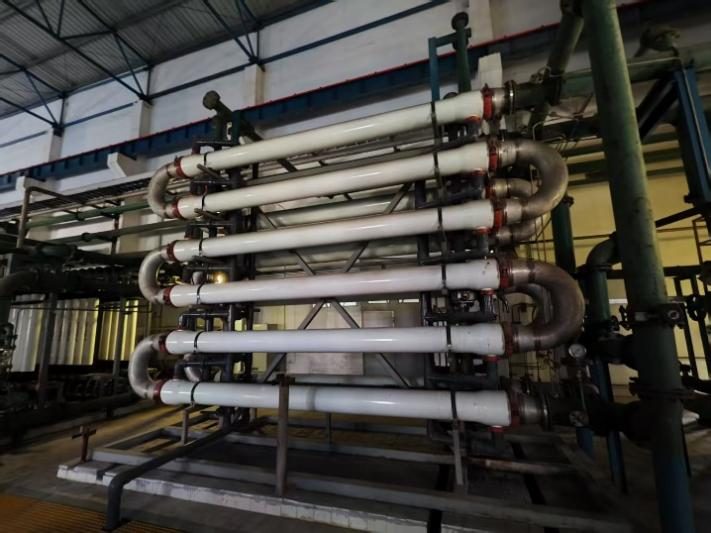
Three readings, three different jobs
Each one answers a different question, and none of them substitutes for the other two.
| Reading | What it actually measures | Where it belongs |
|---|---|---|
| Turbidity (NTU / FNU) | Light scattered by suspended and colloidal matter. An optical surrogate for solids, not a mass. | Outlet compliance, pretreatment performance, membrane integrity. |
| TSS (mg/L) | Dry mass of solids retained on a filter. A mass concentration, carrying no information about size, shape or oil. | Inlet design: cake load, cleaning frequency, channel choice. |
| SDI (SDI15) | The rate at which a 0.45 µmm filter plugs under a fixed pressure. A fouling rate, not a concentration. | Downstream: what the RO or NF stage will have to live with. |
Descriptions only. Which reading governs a project is decided by the permit, the feed and the downstream stage — not by a table.
Why turbidity cannot size a membrane
Turbidity is a good instrument doing a job it was never meant to do. Four reasons it cannot carry a sizing decision:
It saturates
Above a few hundred NTU most turbidimeters stop being linear and start saying only that the water is dirty. High-solids streams live in exactly that range.
It cannot see size
A litre of 1 µmm colloid and a litre of 100 µmm sand can read the same. One forms a thin cake that backwashes off; the other settles in the header and plugs a channel.
It barely sees oil
Emulsified oil scatters light weakly and blinds a membrane quickly. A clear-looking sample with oil in it is the most expensive kind of clean.
It moves with colour
Dissolved colour and fine organics raise the reading without adding anything the membrane will retain. Turbidity can climb while the solids load falls.
Why TSS on its own is not enough either
TSS fixes the mass load. It says nothing about how that mass behaves on a surface, and behaviour is what decides the channel, the cleaning interval and the pump.
- Particle size distribution. The same 2,000 mg/L behaves very differently as sand or as gel-like floc.
- Oil and grease. Free oil floats; emulsified oil coats. Neither is fully captured by a TSS test.
- Viscosity. A concentrated stream at 15 °C and at 40 °C is two different fluids to a pump and to a membrane.
- Temperature. It moves viscosity and the solubility of the scalants behind the membrane at the same time.
- The worst hour. Design on the peak the plant actually sees, not the average the lab received.
SDI is an RO number, not a UF number
SDI is measured by how fast a 0.45 µmm filter plugs. That is a statement about the fouling rate of what comes next, which is why it belongs to the RO or NF stage. A UF permeate is often given an SDI target as a promise to the stage behind it — that is a result to be demonstrated on your feed, not a property you can design the UF on.
What we ask for before sizing anything
Six categories, in this order. Without them a number is a guess with a unit attached.
- Basics — flow, hours of operation, discharge or reuse target.
- Water composition — pH, temperature, TSS, COD, oil, salinity, hardness, silica.
- Physical properties — viscosity, particle size distribution, settleability, scaling and fouling tendency.
- Permeate target — turbidity, SDI, recovery, discharge or reuse standard.
- Site conditions — space, temperature envelope, utilities, cleaning chemicals available.
- Existing system — PFD, equipment list, operating data, failure and cleaning records.
Turbidity is an optical surrogate and belongs on the outlet; TSS is a mass concentration and belongs on the inlet. A membrane is sized on TSS, particle size distribution, oil and viscosity at the worst hour — turbidity sizes the pretreatment in front of it. Confirm all of it on your own feed before the number goes into a datasheet.
Common questions
You can start a conversation on it. You cannot size on it. Turbidity can confirm that a stream is dirty and can show that a pretreatment is working; it cannot tell a 1 µmm colloid from 100 µmm sand, and those two need different channels.
No. The permit governs the outlet. The design is governed by the inlet. A plant can meet an NTU limit and still blind its membrane, because the thing blinding it — oil, or a gel layer — is not what the turbidimeter is counting.
For a first estimate, often yes. TSS plus particle size, oil and viscosity is what turns an estimate into a selection.
Downstream. It is the number the RO stage cares about. On a UF permeate it is an outcome to be demonstrated on your feed, not an input you can design from.
Send the analysis, not the flow rate
A flow rate tells us the size of the problem. A water analysis tells us which membrane line to look at. Send the report you have, including the parts you think are incomplete — the gaps are usually the interesting part.
More on this: Selection guide · Hollow fibre vs tubular UF · What UF does not remove · Sample and pilot testing