
Test the membrane on your feed before anyone commits to a train
Flux, cleaning interval and solids tolerance cannot be read off a datasheet — they depend on the stream. A bench test and a pilot turn three guesses into measured numbers, and they are the cheapest part of the project.
Why these three numbers have to be measured
Design flux, cleaning interval and achievable recovery set the element count, the tank volumes and the chemical consumption. None of them is a property of the membrane alone. They are a property of the membrane against a particular feed, at a particular temperature, with a particular pre-treatment.
Two plants at the same TSS can differ threefold in cleaning interval. The difference is in the particle size distribution and the oil.
This is why we do not publish fixed flux figures. A number that is right for one leachate is wrong for the next one, and a buyer who sizes on a catalogue figure finds out during commissioning.
Two steps, and most projects need both
1 · Bench test on a sample
- Send 5–20 L of feed, chilled or preserved
- We run it across the candidate element at your operating temperature
- You get back a flux curve, a cleaning trial, and a plain answer on whether the element is the right tool
- About two weeks from sample arrival
2 · Pilot on your site
- The skid ships to site and is plumbed into your stream
- It runs until the cleaning interval repeats — typically 4–8 weeks
- You get back measured flux decline, a chemical cleaning recipe, and the sizing basis for the full train
- The skid can be rented, or bought and credited against a later order
What is on the skid
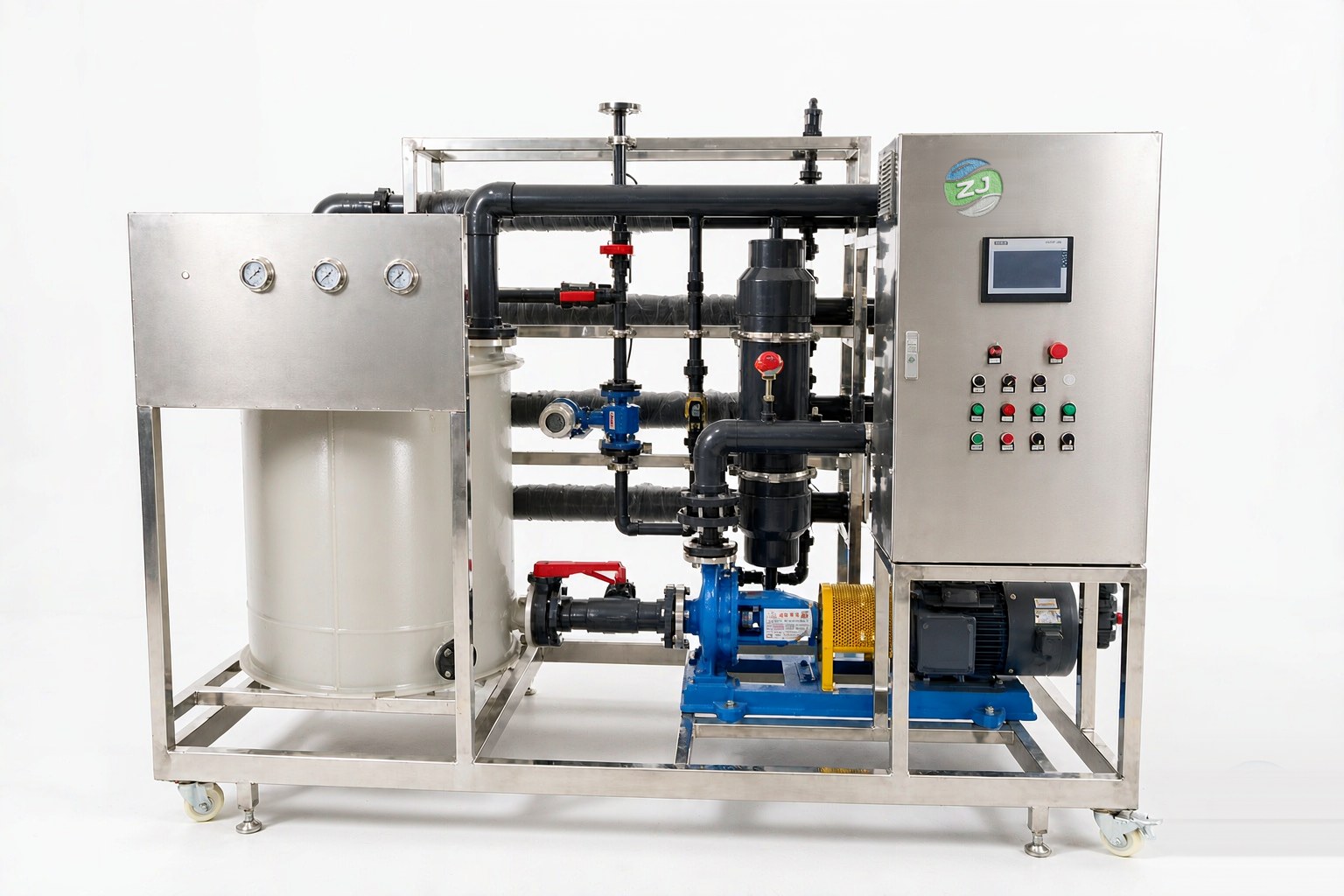
- Stainless steel frame on castors, so it moves between sampling points
- Four element positions, 1 m or 1.5 m elements
- 5 L backwash tank with timed backwash
- Variable-speed feed pump
- Pressure and flow instrumentation, local readout
- Integral control cabinet with data logging
Element count, pump size and instrumentation are configured per project. The skid is built against the duty, not sold from a list.
What to send, and what you get back
Three numbers are enough to start
- Peak TSS — and the average, if you have it
- Oil content — including whether it emulsifies
- Salinity or conductivity — plus the target recovery if you have one
Useful extras: temperature range, pH swing, the worst hour the plant has seen, and any upstream step that can dump oil or solvent.
What you get back
- A view on which configuration fits — hollow fibre, tubular UF, TMF, or an open-channel RO stage
- The boundaries that apply, stated plainly, including where a membrane is the wrong tool
- Whether a pilot is warranted before anyone commits to a train
No obligation, and no quotation before the feed is understood.
Request a sample test or a pilot
Fill in what you know and press the button. It builds a formatted email in your own mail client — nothing is submitted to a server, and you can edit it before sending.
FAQ
5–20 L is enough for a flux curve and a cleaning trial. Send it chilled and unpreserved if it reaches us within 48 hours; otherwise freeze it or add a biocide, and tell us what you added.
Long enough for the cleaning interval to repeat at least twice — typically 4–8 weeks. A shorter run gives a flux figure but not a cleaning recipe.
Yes. It can be rented for the trial period, or purchased and credited against a later full-scale order.
We say so after the bench test, before you spend money on a pilot.
More on selection: Selection guide · Tubular UF · Contact