
TMF softening membrane
Chemical softening and membrane separation in a single stage. The hardness comes out as sludge, the sludge is concentrated continuously and discharged, and the permeate goes on to the high-recovery RO train without the scaling load that would otherwise limit its recovery.
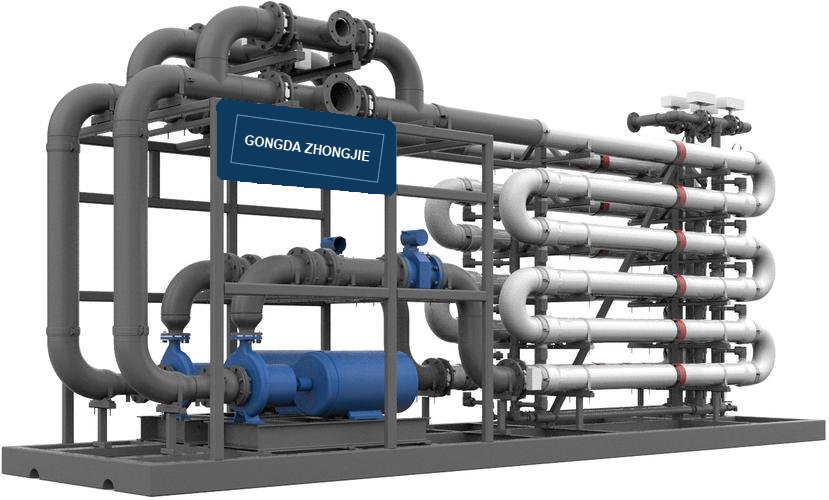
How it works
Rather than softening in a clarifier and then filtering the result, TMF runs the softening reaction and the separation together. The system operates as a continuously concentrating loop: solids build up in the loop rather than being flushed out, and once the sludge reaches the target concentration it is discharged and dewatered.
Reported operating window of 3%–5% solids is drawn from public material and must be confirmed against the actual feed and reagent regime.
What that changes downstream
Hardness is the usual reason a high-recovery RO train has to stop short of its target recovery. Removing it upstream of the membrane — rather than managing scale on the membrane itself — moves the constraint out of the RO stage and into the softening stage, where it is easier and cheaper to handle.
Where it is used
Hardness removal ahead of RO
Removing scale-forming ions upstream so that the RO stage can run at higher recovery.
Zero liquid discharge trains
Pre-treatment ahead of STRO/DTRO and the evaporation stage, where scaling is the binding constraint.
Sludge-generating softening duty
Where softening produces a sludge stream that has to be concentrated and dewatered as part of the process.
TMF is a softening and separation step. It is not a dissolved-solids removal step — hardness ions are precipitated chemically, not rejected by size. Where dissolved contaminants such as arsenic, iron or manganese in true solution are the target, the removal step has to be oxidation, adsorption, ion exchange or reverse osmosis. See the selection guide.
Specification
| Parameter | Value | Note |
|---|---|---|
| Function | Chemical softening + membrane separation | Coupled in one stage |
| Sludge handling | Continuous concentration and discharge | Discharged sludge is dewatered separately |
| Reported solids window | 3%–5% | From public material — confirm against your feed |
| Membrane format | Tubular, open channel | Consistent with the tubular range |
| Recovery, flux, pressure | Confirmed per project | Established during pilot work |
| Reagent regime | Confirmed per project | Depends on feed hardness and target |
Hardness, recovery and the RO stage
Tell us your feed hardness, target recovery and concentrate handling constraint. We will tell you whether softening upstream is worth it — and what it does to the rest of the train.
Send your feed data