
GDZJ‑TUF‑8830‑F
Read left to right. The first field says who made it, the second what family it belongs to, and the last five describe the physical element you are going to install.
TM = tubular MF
Field by field
| # | Field | Code | Meaning |
|---|---|---|---|
| 1 | Brand | GDZJ | GONGDA ZHONGJIE — Jiangsu Zhongjie Environmental Technology Co., Ltd. |
| 2 | Series | TU / TM | TU = tubular ultrafiltration; TM = tubular microfiltration |
| 3 | Membrane material | F | Separation layer material — PVDF, PES or modified PVDF |
| 4 | Channel bore | 6 / 8 / 10 / 12.7 / 25 | Inner diameter of the membrane tube, in mm. Sets the largest particle the channel passes and how much solids load it tolerates. |
| 5 | Element outside diameter | 3 / 4 / 6 / 8 / 10 | Nominal element diameter, in inches |
| 6 | Element length | 10 / 18 / 30 | 10 = 1 m; 18 = 1.83 m; 30 = 3 m |
| 7 | Housing material | S / F / P / C | S = stainless steel or PES; F = FRP (glass-reinforced plastic); P = PVC; C = CPVC |
GDZJ-TUF-8830-F — tubular ultrafiltration, PVDF-class membrane, 8 mm channel bore, 8 inch element outside diameter, 3 m long, FRP housing.
Housing letter follows the chemistry and the pressure class, not the element size. On aggressive or high-chloride streams the housing is usually specified first.
Three of the seven fields do the selection work
Channel bore sets solids tolerance
A wider bore passes larger particles and takes a higher solids load before it plugs, at the cost of membrane area per unit volume. A narrower bore gives more area in the same shell.
Diameter and length set the area
Element outside diameter and length together fix the membrane area per element, which in turn fixes how many elements the duty needs.
Housing sets the corrosion class
PVC, CPVC, FRP and stainless/PES cover different pH windows, chloride levels and pressure ratings. The cheapest housing that survives the stream is the correct one.
Membrane material first, decided by pH and temperature. Channel bore second, decided by solids content and particle size. Then outside diameter and length for the area you need, and the housing last, against the chemistry and pressure class. Working in that order avoids the usual mistake of sizing the element before checking whether the material survives the stream.
Component dimensions and membrane area
The table below gives the outline dimensions and membrane area of the main non-woven tubular models. Dimensions A to F are the outline control dimensions used when designing the rack and the pipework; the dimensional drawing that defines each one is supplied with the quotation.
| Model | Membrane area (m²) | Channel bore (mm) | A (mm) | B (mm) | C (mm) | D (mm) | E (mm) | F (mm) |
|---|---|---|---|---|---|---|---|---|
| GDZJ-TUF-8430-F | 6.4 | 8 | 3000 | 114.3 | 107 | 80 | 48 | 98 |
| GDZJ-TUF-8630-F | 15 | 8 | 3000 | 168.3 | 160 | 90 | 60 | 150 |
| GDZJ-TUF-6830-F | 34 | 6 | 3000 | 219.1 | 210 | 90 | 73 | 165 |
| GDZJ-TUF-8830-F | 27 | 8 | 3000 | 219.1 | 210 | 90 | 73 | 165 |
The dimensions above are outline control dimensions for rack and pipework design. Operating flux, pressure and cleaning interval are not published as fixed values, because they depend on the feed — they are established on your stream, normally during a pilot. Confirm the final element selection against your own feed data before placing an order.
Non-woven supported, double-layer welded
The element is built as three layers. An imported non-woven support gives the tube its mechanical strength and keeps it from snapping under pressure cycling. A double-layer weld joins the assembly and takes the fatigue of repeated backwashing. The separation layer sits on top, in PVDF, PES or modified PVDF depending on the chemistry it has to survive.
The practical consequence of that construction is that the element can be cleaned by backwash, by chemical cleaning and by mechanical scrubbing — used in combination, rather than relying on any one of them. That is what supports the reported service life of five years and beyond on the tubular range.
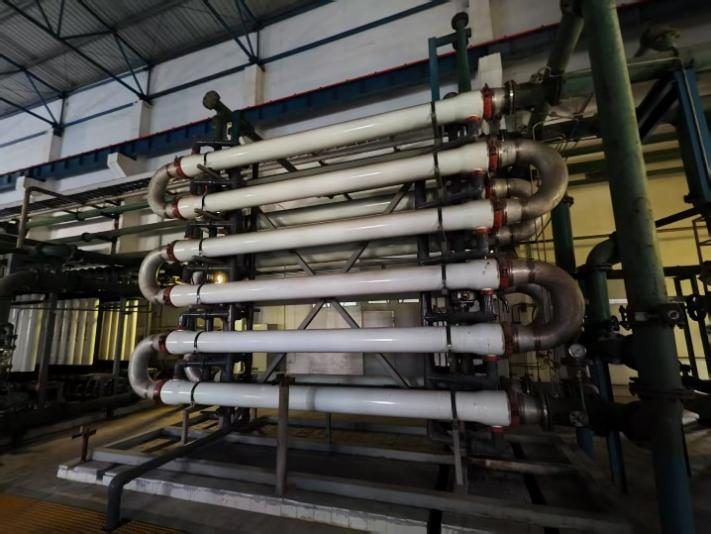
Element behaviour on difficult feeds: tubular ultrafiltration · selection guide
Give us the feed, we will give you the code
Send the pH and temperature range, the peak solids, the particle size distribution if you have it, and the oil content. That is enough to fix fields 3 to 7 and tell you how many elements the duty needs.
Send your feed data