
Tubular ultrafiltration
An open-channel membrane for feeds that would blind a hollow-fibre module. The stream runs inside the tube under pressure, in crossflow, and the solids that do not pass through the wall keep moving instead of settling onto a packed fibre bundle.
How crossflow works inside the tube
The feed is the channel. It enters the tube under pressure, runs along the inside at speed, and the fraction that passes through the wall is collected as permeate. Everything the wall rejects stays in the channel and is carried out the far end as concentrate — it does not settle into a static cake.
Turbulence at the surface
Flow along the wall keeps the liquid at the membrane surface in turbulent motion, which works against particles accumulating into a compacted cake layer.
Continuous sweeping
Suspended solids leave the module with the concentrate rather than building up in place. Crossflow slows the growth of the cake layer; it does not stop it, and cleaning intervals still have to be established on the real feed.
Stable flux over time
Because solids do not sit on the membrane surface, flux holds steadier between cleans than in a dead-end configuration.
At a glance
| Parameter | Value | Note |
|---|---|---|
| Channel diameter | 8 mm and 5.2 mm | Larger channel for higher solids and larger particles |
| Nominal pore size | 0.03 µm | Ultrafiltration range |
| Flow configuration | Inside-out (inner pressure), crossflow | The feed is the channel; the permeate passes through the wall |
| Cleaning | Mechanically cleanable | Not limited to backwash-only recovery |
| Membrane material | Organic / polymeric | Grade confirmed per project against the feed chemistry |
| pH and temperature window | Confirmed per project | Depends on membrane grade and the cleaning regime |
| Flux and operating pressure | Confirmed per project | Established on the actual feed, normally during a pilot |
We do not publish fixed flux or pressure figures. They depend on your feed, and a number that is right for one plant is wrong for the next.
How the element is built
Three layers, and each one is doing a different job. An imported non-woven support gives the tube its mechanical strength. A double-layer weld joins the assembly and absorbs the fatigue of repeated backwashing and pressure surges. The separation layer sits on top of that, in PVDF, PES or modified PVDF depending on the chemistry it has to survive.
The reason this matters commercially is service life. A support structure that holds its mechanical strength is what allows the element to be cleaned repeatedly — by backwash, by chemical cleaning and by mechanical scrubbing — and still recover its flux. That combination is the basis of the reported five-year-plus life on this range.
Maximum inlet pressure 10 bar, which leaves headroom to raise crossflow velocity on viscous feeds. Filtration rating across the range: 30–200 nm.
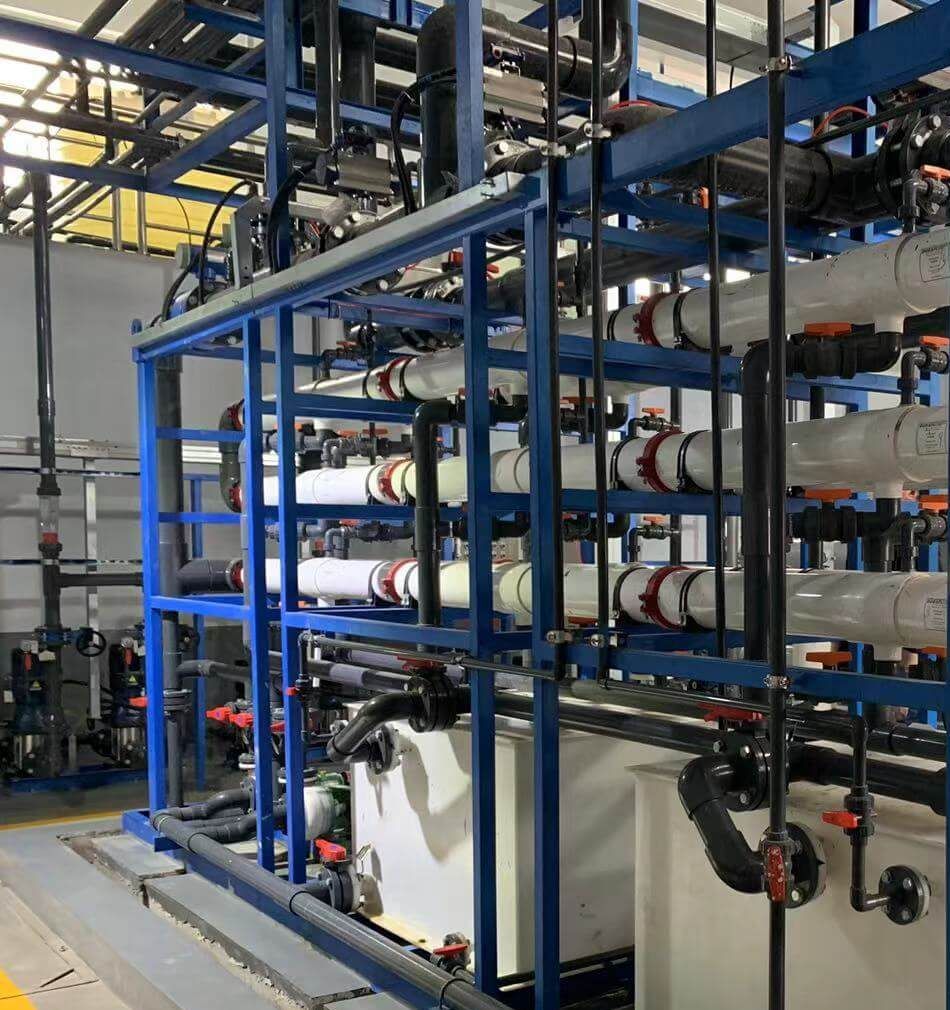
Where tubular UF is the right choice
Above roughly 3% suspended solids, tubular configurations are the practical choice, because the open channel tolerates the solids load and can be cleaned mechanically rather than by backwash alone. Between 1% and 3%, either configuration can work and the deciding factors are viscosity, particle size distribution and oil content.
Rule of thumb from field experience. Confirm against your own feed data before sizing.
Typical duties
- Biological sludge separation
- Oily and emulsified industrial wastewater
- High-solids effluent ahead of a RO train
- Material concentration and recovery
- Landfill leachate pre-treatment
Why oil matters more than solids
Oil blinds a membrane before solids do, and it does not come off with a normal backwash. Where the feed can carry oil, the configuration question is usually settled by the oil number rather than the TSS number — see the selection guide.
Hollow fibre or tubular?
Hollow fibre is the right answer more often than not — it packs more membrane area per unit volume and costs less per square metre. We will tell you when it does. Tubular becomes the answer when the feed would block or irreversibly foul the fibre bundle.
| Consideration | Hollow fibre | Tubular |
|---|---|---|
| Solids tolerance | Typically up to ~1% | Above ~3%, and the practical choice in between |
| Oily or emulsified feed | Oil blinds the fibre and resists backwash | Wall shear keeps oil moving |
| Cleaning | Backwash-based | Mechanically cleanable |
| Membrane area per unit volume | Higher | Lower |
| Cost per m² of membrane area | Lower | Higher |
Send us three numbers
Peak TSS, oil content and salinity. That is enough for us to tell you which configuration to look at first — including whether hollow fibre would do the job for less money.
Send your feed data