
Choosing a membrane configuration on a difficult feed
Four questions decide most membrane selections: how much solid the feed carries, whether it carries oil, how saline it is, and what has to be removed that a membrane cannot remove. This page sets out where each configuration stops making sense.
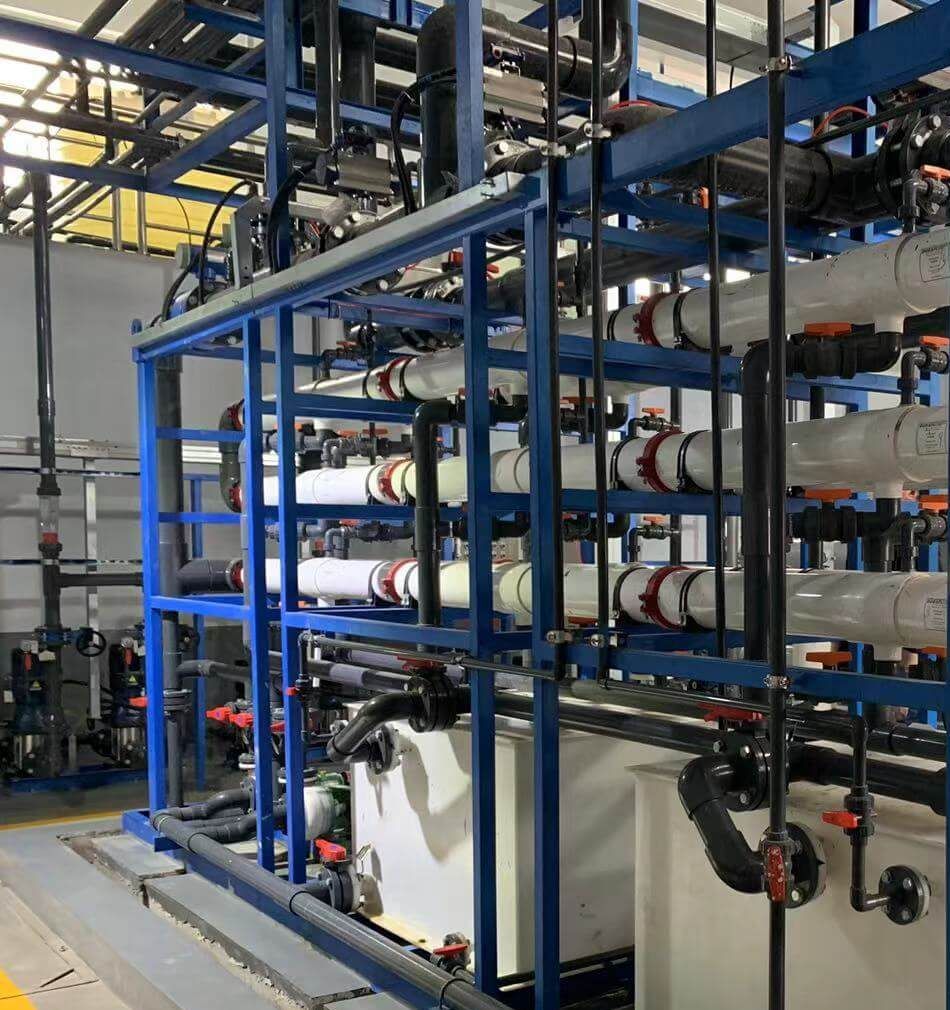
1. How much solid is in the feed
Hollow-fibre UF is typically specified up to about 1% suspended solids (roughly 10 g/L). Between 1% and 3%, either configuration can work, and the deciding factors are viscosity, particle size distribution and oil content. Above roughly 3% solids, tubular configurations are the practical choice: the open channel tolerates the solids load and can be cleaned mechanically rather than by backwash alone.
Rule of thumb from field experience. Confirm against your own feed data before sizing.
The reason the boundary is not a single number is that solids concentration is only a proxy. What actually blocks a membrane channel is the combination of concentration, particle size distribution and viscosity — a 2% stream of coarse, free-settling particles behaves very differently from a 2% stream of fine colloidal material, even though the gravimetric result is the same.
That trade-off is worked through in detail in choosing between hollow-fibre and tubular UF by feed solids.
2. Turbidity and TSS answer different questions
Turbidity (NTU) is an optical surrogate and is normally an outlet-side compliance parameter. TSS (mg/L) is a gravimetric measurement and is the feed-side number used to size a membrane.
The two can diverge. A first-flush rain event can lift TSS sharply while turbidity barely moves, because the additional solids are coarse and settle out of the sample before it is read. If a plant logs only turbidity, the solids excursion that matters to the membrane may not appear anywhere in the record.
This is one reason we ask for peak solids rather than peak flow, and for the worst hour rather than the daily average.
In practice, a membrane quotation built on turbidity data alone tends to be under-sized for the events that actually foul it. If your plant records turbidity for discharge compliance, that is the right number for the permit — but not for the membrane.
3. Oil changes the answer more than solids do
Oil blinds a membrane before solids do, and it does not come off with a normal backwash. Emulsified oil is harder still: once the oil is dispersed rather than floating, gravity separation upstream stops working and the load arrives at the membrane.
Where the feed can carry oil, the configuration question is usually settled by the oil number rather than the TSS number — and the upstream question (can the oil be knocked out before the membrane?) matters more than the membrane selection itself.
4. What ultrafiltration does not remove
Ultrafiltration operates in the 0.01–0.1 µm range. Arsenic, iron and manganese in true solution, hardness ions and most of the dissolved organic fraction pass straight through. If those are the target, UF is a pre-treatment step, not the answer — the removal step has to be oxidation, adsorption, ion exchange or reverse osmosis, depending on the species.
Stated here so that it is not discovered later. A membrane supplier who does not mention this is not doing you a favour.
Full species-by-species breakdown, including arsenic, iron, manganese, hardness and silica: what ultrafiltration does not remove.
5. Crossflow shear slows fouling — it does not stop it
Crossflow shear continuously sweeps material off the membrane surface, which slows the growth of the cake layer. It reduces the rate at which fouling accumulates. It does not prevent it.
This is why cleaning intervals cannot be read off a datasheet. They have to be established on the actual feed, which is the practical argument for running a pilot before committing to a full train.
Flux, pressure and cleaning interval are confirmed per project.
Summary: configuration by feed condition
| Feed condition | Practical starting point | Why |
|---|---|---|
| TSS ≤ ~1% (≈10 g/L) | Hollow-fibre UF | Highest packing density, lowest cost per m² of membrane area |
| TSS ~1–3% | Either — decide on viscosity, PSD, oil | Both can work; a pilot decides, not a catalogue |
| TSS > ~3% | Tubular UF | Open channel tolerates solids; mechanically cleanable |
| Oily or emulsified feed | Tubular UF | Wall shear keeps oil moving; oil blinds hollow fibre and resists backwash |
| High salinity, high recovery | STRO / DTRO | Open disc-tube channel resists scaling and fouling |
| Hardness, chemical softening | TMF | Softening coupled with separation; continuous sludge discharge |
Starting points for discussion, not a specification. Final selection follows a pilot on your feed.
Three numbers are enough to start
Peak TSS, oil content and salinity. Send those and we will tell you which configuration to look at first — including the case where hollow fibre would do the job for less money.
Send your feed data