
Crossflow shear slows the cake. It does not stop it.
Crossflow is usually described as if it kept a membrane clean. It does something narrower and more useful: it limits how much cake can sit on the surface at a given flux. Everything that is not cake — gel, adsorption, scaling — keeps happening while the pump runs.
What the shear actually does
In a tubular element the feed travels along the channel at a few metres per second. Two things follow, and both are about the surface rather than the pore.
It limits cake thickness
At steady state the cake stops growing where erosion matches deposition. That is why a tubular element can hold flux on a solids load that would blind a spiral-wound element.
It lowers polarisation
Faster crossflow carries rejected material away from the wall, which keeps the concentration at the surface closer to the bulk at the same flux.
It does not clean the pore
Shear acts on the surface. It has no effect on what has adsorbed inside the pore, or on what has precipitated onto the wall.
It is not free
Pressure drop along the channel rises roughly with the square of velocity, and that energy is paid every hour the plant runs.
Four mechanisms, one of which shear touches
A fouled membrane does not come with a label. The useful question is which of these is accumulating, because three of the four are beyond what flow alone can remove.
| Mechanism | Signature | What brings it back |
|---|---|---|
| Cake / particulate | TMP climbs with throughput, then flattens. Flush water comes out dirty. | Backwash, forward flush, air scour. Mostly reversible. |
| Gel / concentration polarisation | TMP rises sharply above a threshold flux, then stabilises below it. | Lower flux. Shear helps, but it cannot push past the limiting flux. |
| Adsorption / pore blocking | Flux does not return after a water flush. CIP outlet is coloured. | Chemical cleaning matched to the foulant. Part of it is permanent. |
| Scaling | Recovery drifts down, TMP climbs slowly, acid or alkaline CIP recovers part of it. | Cleaning plus a change in pretreatment or recovery — otherwise it returns. |
A plant can show all four at once. The reading that separates them is not the absolute TMP; it is the rate of change and what comes back after cleaning.
Why an open channel is not the same as no fouling
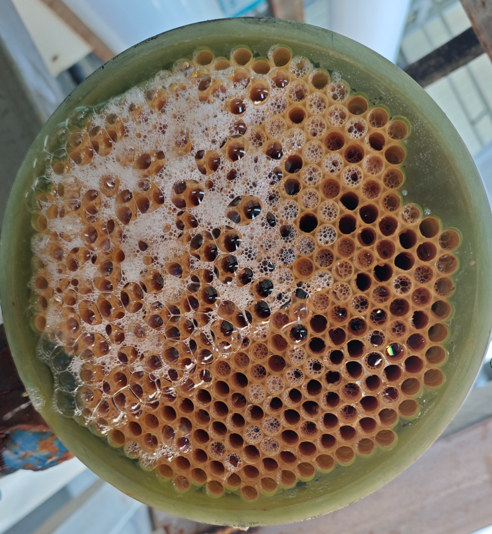
An 8 mm channel tolerates solids that would plug a 1 mm channel. That is a statement about plugging, not about fouling. The deposit that costs you flux does not care how wide the channel is.
The real advantage is mechanical. A channel that size can be brushed, flushed or air-scoured in place, so the element goes back to flux instead of being replaced. Open channel is the main reason a tubular element survives a dirty feed — it is not the only reason, and it is not a cleaning regime.
Where shear stops paying
More velocity is not automatically better. Four costs sit on the other side of the equation:
- Pressure drop — roughly the square of velocity, for the life of the plant.
- Energy — the recycle pump is often the largest single load on a tubular skid.
- Floc shear — at high velocity, fragile floc breaks into fines that then blind the cake. The pump can make the feed harder to filter.
- Heat — that energy ends up in the water, which matters in a hot climate and in a closed loop.
Three readings that tell the mechanisms apart
All three are trends, not set points. None of them is a catalogue value.
- Normalised flux at a reference temperature — removes the temperature effect so the trend means something.
- TMP rise per cubic metre permeated — the slope, not the value. A slope that steepens is a mechanism change.
- Recovery after cleaning — the share of the previous clean-water flux that comes back. A recovery that falls over successive cleans is the signal that something irreversible is accumulating.
Crossflow shear limits cake thickness and lowers concentration polarisation; it does not remove adsorbed or precipitated material, and it cannot push a membrane past its limiting flux. Judge it by the TMP slope and by the flux recovered after cleaning — measured on your feed, at your temperature, over weeks rather than days.
Common questions
No. It reduces cake and polarisation up to a point, then costs pressure drop, energy and floc integrity. There is an optimum, and it is set by the feed rather than by a catalogue.
Not on a fouling stream. Shear handles the cake; it does not handle adsorption or scaling. Cleaning intervals are a pilot result, not a specification.
The flush removes the cake. What remains is the slower, partly irreversible part — adsorption, pore blocking, and scale that the flush never reached.
They do different jobs. Backwash pushes permeate backwards through the wall to lift the cake; crossflow keeps the cake from building in the first place. Most tubular systems use both, plus chemical cleaning.
Measure it on your stream, not on ours
The shear that matters is the one that holds your flux between cleanings on your feed. That is a pilot result. Send the feed data and the cleaning history, and we will tell you what the pilot should measure.
More on this: Selection guide · Hollow fibre vs tubular UF · What UF does not remove · Sample and pilot testing